
Virtual Power Purchase Agreements (VPPAs)
Virtual Power Purchase Agreements (VPPAs) with Alberta Renewable Energy & Energy Storage Projects
Why Enter Into a Virtual Power Purchase Agreement and Who Can Do It?
Virtual Power Purchase Agreements (VPPAs) are a transaction structure that provide corporations the opportunity to profitably reduce their net carbon emissions and future electricity price exposure without incurring any upfront capital expenditures. As of September 2026, the 24×7 forward electricity price in Alberta for the years 2027-2031 was $67/MWh, and the effective market price of a carbon offset in Alberta’s TIER market was $29/tonne. As a result, entering into a well-structured virtual power purchase agreement with a cost-effective and strategically located project in Alberta can provide corporations with a profit on the transaction.
Since 2017, corporations have entered into virtual power purchase agreements with renewable energy and energy storage projects in Alberta in order to:
1) Meet government-mandated carbon compliance obligations (such as the Technology Innovation and Emissions Reduction Regulation in Alberta);
2) Offset hard-to-abate carbon emissions and achieve voluntary net carbon emissions reduction targets and meet ESG goals; and,
3) Hedge their long-term exposure to rising Alberta electricity and carbon prices.
What is a Virtual Power Purchase Agreement and How Does a Virtual Power Purchase Agreement Work?
A power purchase agreement is an agreement to pay an electricity generator a predetermined price for each unit of electricity that the project generates. In return for this payment, the power purchase agreement Buyer receives either the physical delivery of the electricity (physical PPA) or the market price of that electricity received by the electricity generator (virtual PPA), along with the associated carbon offsets.
Thus, when the market price is higher than the predetermined price at which the electricity will be purchased, the PPA Buyer gets paid (or achieves electricity cost savings) and receives the carbon offsets. However, when the market price is lower than the predetermined price at which the electricity will be purchased, the PPA Buyer will pay the difference to the electricity generator (while still receiving the carbon offsets).
How Is It Possible To Make Money And Achieve Carbon Emissions Reductions?
In a virtual Power Purchase Agreement, the Buyer will receive the market electricity revenue and the value of the carbon offsets in exchange for a predetermined cost per unit of electricity.
Thus, if the market electricity revenue is higher than the predetermined cost per unit of electricity, the PPA Buyer gets paid while also achieving carbon emissions reductions.
The three main factors driving the economics of virtual Power Purchase Agreements with wind and solar power generation projects in Alberta are: the cost of wind and solar energy system generation, electricity market prices, and carbon market prices. In slight divergence, the three main factors driving the economics of virtual Power Purchase Agreements with energy storage projects in Alberta are: the cost of building and connecting the energy storage project, the volatility of electricity and ancillary service market prices, and the location of the project.
The 2026 Levelized Cost of Energy Report published by Lazard on the levelized cost of electricity noted that unsubsidized renewable energy remains the most cost-competitive form of new-build generation on an LCOE basis. As a result, wind and solar energy project developers are able to profitably enter into power purchase agreements at or below the forecasted market price of electricity in Alberta.
For example, the Government of Alberta announced that they entered into a virtual power purchase agreement to pay an average fixed price of $48.05/MWh to three solar projects, and prices that ranged between $30.90 and $43.30/MWh to ten wind projects.
While other virtual power purchase agreement contracts have not been publicly disclosed, it is likely that these prices currently represent the lowest virtual power purchase agreement prices for solar power and wind projects in Alberta, as the government is a counterparty with a very high credit rating and ran a highly competitive auction process.
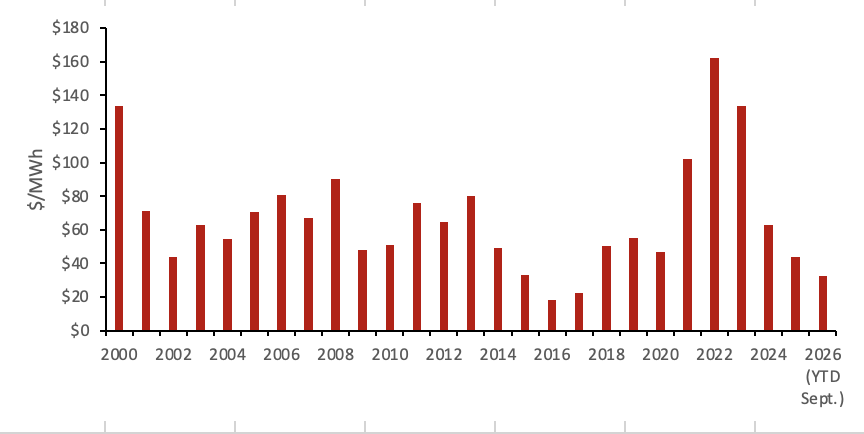
To put the above-listed virtual power purchase agreement contract prices into context, the average all-hour electricity price in Alberta from the start of 2000 through to September 2026 was $67/MWh, with current forward curves and widely used long-term market forecasts projecting prices to remain above the current cost of renewable energy generation.
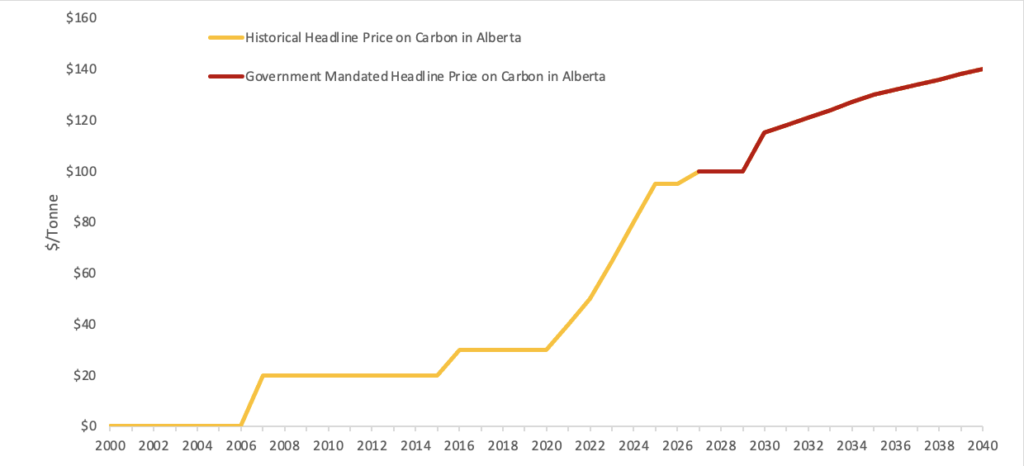
Additionally, the federal government of Canada and the provincial government of Alberta have entered into an agreement to increase the headline price on carbon from the current price of $95/tonne in 2026 to $100/tonne in 2027 where it will remain until 2029 before increasing to $115/tonne in 2030. Following this it will increase by $3/tonne per year until it reaches $130/tonne in 2035, and then it will increase at 1.5% per year until it reaches $140/tonne in 2040. These committed increases will see the value of the carbon emissions reductions continuing to rise, further enhancing the value to the PPA Buyer.
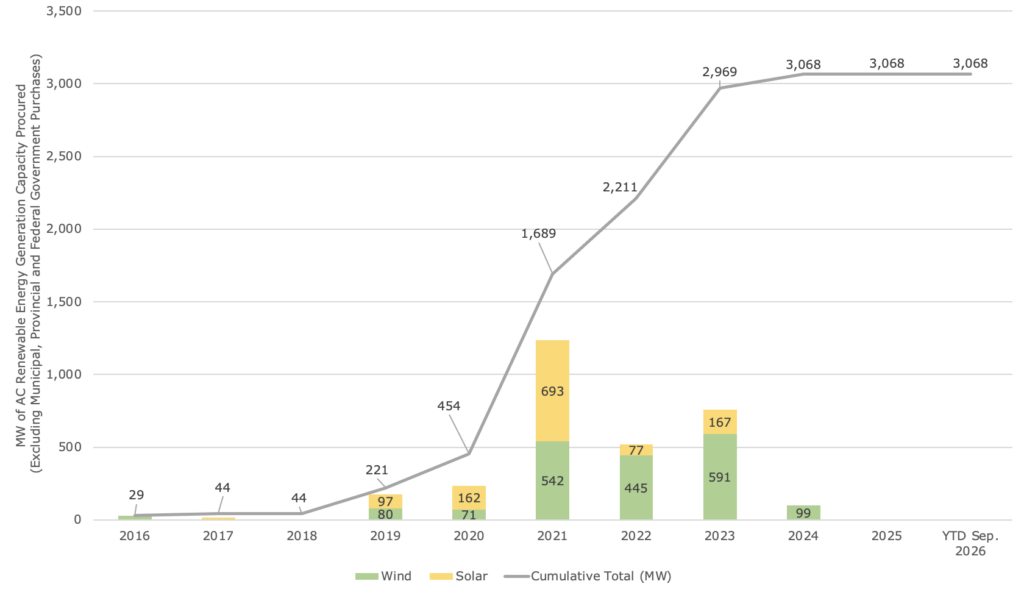
Virtual power purchase agreements with utility-scale wind and solar energy generation projects in Alberta experienced notable transaction volumes in 2021, 2022, and 2023. Over the course of 2024, 2025, and 2026, transaction volumes have declined, primarily driven by:
- A 7-month moratorium on the issuance of project approvals for new wind and solar projects that was imposed in August 2023;
- A restructuring of the electricity market in Alberta that commenced in March 2024 and is scheduled for implementation in mid 2027; and,
- Declining market-based revenues earned by the projects.
With the moratorium lifted in Febraury 2024, the restructured electricity market rules approved in March 2026, and the forward electricity price curves rising due to the incoming data centers, we expect PPA transaction announcements to begin increasing again in 2027.
How To Source A PPA and Maximize the Value of Your Contract?
Each wind and solar energy project will have different economics based on variables such as the interconnection costs, project size, cost-effectiveness of the project design, and procurement and construction costs.
Furthermore, some project owners have a higher cost of capital and return expectation than others, driving up the rate at which they are willing to transact under a virtual power purchase agreement.
While the headline price at which the electricity is purchased often gets the most attention, other aspects that can have a greater impact on the value of the virtual power purchase agreement contract to the VPPA Buyer include: the remaining development risk of the project, the timeline to project completion, the electricity generation profile of the project, the electricity generation profile of the customer (for Alberta-based load), the location of the project, the date at which the project reaches commercial operation, and the allocation of risk and guarantees provided within the contract itself.
In order to maximize the value of a Virtual Power Purchase Agreement contract, VPPA Buyers should:
1) Aggregate with other buyers to increase their purchasing power and transact with larger projects that benefit from economies-of-scale pricing;
2) Screen projects for development status and project risks;
3) Screen projects for locational congestion and pricing risk;
4) Run a competitive process to evaluate multiple offers;
5) Conduct financial modelling to quantify the value and risk associated with each offer; and
6) Negotiate a contract that properly allocates the risk.
To summarize, while price is an important aspect of a virtual power purchase agreement, it isn’t the only item that matters. Simply put, price is what you pay; value is what you get.